
IIMB-CCGS International Conference on Corporate Governance & Sustainability puts AI accountability, boardroom oversight and long-term governance to the test
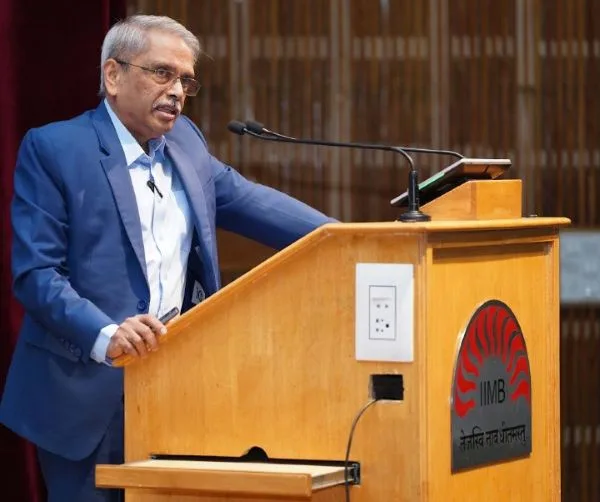
20 November, 2026, Bengaluru: “Governance is not about compliance. I think it’s about whether a company will still be here, still be trusted, 20 years from now”. That was the question Mr. Kris Gopalakrishnan, Chairman, Axilor Ventures and Co-Founder of Infosys, placed at the heart of his keynote address at the International Conference on Corporate Governance & Sustainability, inaugurated today at IIM Bangalore.
The two-day conference, hosted by IIMB’s Centre for Corporate Governance & Sustainability (CCGS), brought together academics, industry leaders and policymakers to examine the demands that technological disruption, geopolitical uncertainty and sustainability imperatives are placing on corporate governance. The formal inauguration featured Mr. Kris Gopalakrishnan; Prof. Padmini Srinivasan, Chairperson, CCGS and faculty, Finance & Accounting area, IIMB; Prof. Sourav Mukherji, Dean, Faculty, IIMB; Prof. Sanjay G Kallapur, faculty of Accounting, Indian School of Business (ISB); and Mr. Soumitra Bhattacharya, Chairman & Non-Executive Director, Bosch Limited and Member, Advisory Committee, CCGS.
Welcome address
Welcoming delegates from academia, industry and policy, Prof. Padmini Srinivasan observed that corporate governance was being reshaped by an unusually complex confluence of geopolitical disruptions, supply-chain vulnerabilities, technological acceleration, sustainability imperatives and stakeholder activism.
AI, said Prof. Padmini, presents unprecedented opportunity for transformation, and yet raises questions of key significance around algorithmic bias, employment, privacy, overreliance and accountability. Establishing robust governance frameworks that clearly define responsibility across its development, deployment and regulation is key to mitigating systemic risks early, she added. On environmental sustainability, she highlighted the cost considerations that continue to influence and deter organizational priorities.
Prof. Srinivasan also acknowledged the contributions of the conference committee, the CCGS Advisory Board, sponsors and the IIMB community. Established two decades ago, the Centre was founded on the pioneering contributions of the late Prof. N. Balasubramanian.
“Measure transformation, not just AI adoption”
Delivering the keynote address on ‘AI, Governance and the Board’, Mr Kris Gopalakrishnan made a compelling case for viewing corporate governance as a determinant of institutional longevity.
Describing ‘longevity’ as the most meaningful measure of success, he identified three interdependent foundations of a durable enterprise: long-term value creation through predictable and profitable growth; stakeholder trust built on fairness, transparency and integrity; and the organizational capability to adapt through values-led innovation. Governance, he pointed out, makes these outcomes more predictable. “Without it, success is luck; with it, success becomes a habit.”
On the inflection point that AI represents within a broader information revolution, he said, “Do not create siloes as AI touches everything – audit, risk, technology, nomination and remuneration, as well as executive leadership”.
One of his sharper interventions concerned the growing use of autonomous AI agents. “Treat agents as delegated actors within a controlled system – not as accountable persons”, said Mr. Gopalakrishnan, adding that every delegation must have an identifiable owner, clearly defined scope and permissions, operating limits, logs, monitoring and a human override.
Calling for a shift in how organizations assess technological progress, Mr. Gopalakrishnan said, “Measure transformation, not just AI adoption.” Counting the number of AI pilots launched, he argued, is no measure of strategic progress. Enterprises must instead evaluate whether AI is strengthening strategy, IP and data capabilities, productivity, safety, trust, innovation and resilience.
He also called for constructive engagement between industry and regulators. Urging directors to build AI literacy, he noted it was vital that they “ask informed questions, challenge evidence, ask for validation and protect accountability to ensure that named executives own outcomes”, so that responsibility does not disappear into a model, vendor or AI agent.
“Govern innovation. Protect trust. Build longevity”, he said, concluding that the value of AI will ultimately depend on ethical adoption, regulatory alignment, stakeholder engagement and effective oversight.
Overcoming hardwired short-termism to protect samaj, sarkar and bazaar
The tension between immediate rewards and long-term institutional value also informed Prof. Sourav Mukherji’s address on organizational design. He questioned the assumptions that often underpin corporate decision-making: do organizations exist primarily to maximize profitability, or should customer and employee welfare also determine how value is created?
Drawing on the distinction between exploration and exploitation, he observed that organizations routinely favour the latter. Exploitation of existing resources offers more immediate payoffs, whereas exploration involves uncertain returns over a longer horizon. Yet the latter is indispensable to innovation and long-term sustainability.
The difficulty, Prof. Sourav asserted, is that our brains are designed to respond to rewards that are tangible, certain, immediate and personal. “Organizations are rarely designed to prioritize long-term outcomes. Nor are we biologically predisposed to do the same”.
Referring to the possibility of recursive self-improvement in AI systems, Prof. Mukherji spoke of growing concerns among AI researchers about ‘catastrophic risks’. “Mitigating the risk of extinction from AI should be a global priority”, he said, arguing that the window for prevention in exponential disasters may close before their consequences become apparent to the wider public.
His closing argument was that governance must serve as a counterweight to the institutional and human tendency to prioritize immediate gains over collective, long-term well-being. It is, he suggested, what can prevent samaj, sarkar and bazaar from rushing headlong towards avoidable doom.
Beyond checkboxes: The realities of corporate governance
In his academic keynote, ‘Checkboxes, Tightropes and Blind Spots: Rethinking Corporate Governance in Practice and Research’, Prof. Sanjay G Kallapur of ISB talked about his research that has been shaped by his experience as a board member, an academic as well as a regulator or “standards setter,” as he put it.
His address examined three interlocking challenges: the tendency to reduce governance to checklists, the difficult position independent directors occupy within boardrooms, and the need to rethink how governance research is conducted.
On regulatory design, Prof. Kallapur explored the gap that can emerge between the intent of a principles-driven mandate and the way organizations respond to it. Well-intentioned requirements, he observed, can sometimes encourage strategic ‘workarounds’ when implementation becomes excessively checklist-driven. The challenge is to ensure that rules advance their underlying governance objectives without losing sight of the practical realities of the market.
In reference to SEBI's disclosure requirements, he described India's corporate governance regulations as among the most stringent in the world. He underlined that regulatory effectiveness must also be assessed through their consequences and the behaviour they tend to incentivize.
Turning to the independent director's position, he described the boardroom as a tightrope. Directors must “maintain a questioning mind, avoid blind reliance on auditors, recognize red flags and remain cognizant of evolving standards”.
Prof. Kallapur called for regulators, lawyers and companies to contribute to building a richer body of cases and practical standards in India. Such guidance, he argued, would help independent directors discharge their responsibilities more effectively, without making the role unnecessarily daunting for prospective board members.
His final argument concerned the direction of accounting and corporate governance research. Calling for a methodological reset, he advocated a return to phenomenon-driven research that begins with the problems organizations actually face. Among the priorities he identified were strategic adaptation, boardroom risk and reporting, and the development of context-specific evidence for Indian institutions, including SEBI and NFRA.