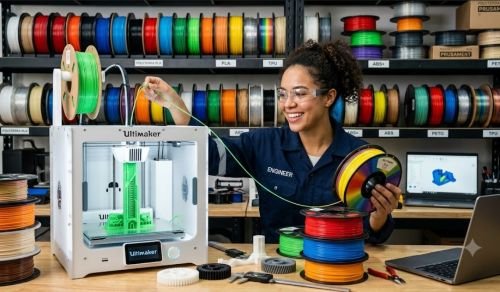
Choosing the right 3D filament will deliver better results for your 3D printing projects and can also help reduce overall 3D printing costs
3D printing can be a fun area to explore, as you can create various simple as well as complex parts. A part that is usually manufactured in a large factory can be easily printed using a 3D printer. If you are looking to get started with 3D printing, it is important to first understand the basics. One of the most important components of a 3D printer setup is the 3D filament. It is available in various materials and usage depends on the type of project you are executing. Let's get more details on this topic.
What is a 3D filament?
In a normal paper printer, the printing is done by specialized ink. In a 3D printer, the ink is basically replaced with a 3D filament. A 3D filament is the raw material that most home and hobby 3D printers use to build objects. A 3D filament is usually around 1.75 mm thick and is available in spools. The material used in a 3D filament is usually plastic, but the exact composition varies.
The 3D filament is fed through a heated nozzle, where it melts and deposits on the base plate in various layers. Gradually, the object you are printing takes shape. One of the most common methods of 3D filament-based printing is FDM (Fused Deposition Modeling). Just imagine the working as similar to that of a glue gun, but with more advanced controls and proper solid shape formation.
Types of 3D filaments
While some 3D filaments can be used interchangeably, it is important that you use the recommended guidelines. The types of 3D filaments may vary based on their hardness, flexibility, heat required, strength, ease of printing and durability. You can use one in place of the other, but choosing the right 3D filament will ensure that your 3D printing project has much better outcomes. Let's take a look at some of the commonly available 3D filaments, which you can consider for your project.
PLA (Polylactic Acid) 3D filament - This is made from plant sources like cornstarch. As such, it is biodegradable and gives off very little smell. It is cheap, easy to print, and produces clean, detailed surfaces. Such properties make it the standard choice for beginners, models, and decorative items. However, a weakness is heat. PLA can soften around 55–60°C. It may not be suitable for 3D printed objects that will be subjected to high heat.
ABS - This is also a common choice for 3D filament. ABS is the tough plastic used in LEGO bricks and car dashboards. It withstands higher heat (around 100°C) and impacts well, but it warps easily while cooling and needs an enclosed printer and good ventilation because of its fumes.
PETG - This is placed between PLA and ABS in strength. It is tougher than PLA, resists water and chemicals better. It can handle heat up to roughly 80°C, while still printing almost as easily. For functional parts that need to actually work, PETG is often the safest all-round choice.
TPU - This is a flexible, rubber-like filament. 3D objects made with TPU bend, stretch, and bounce back. Such properties make it ideal for phone cases, gaskets, and watch straps. However, TPU prints slowly and is relatively trickier to handle.
Nylon - This is one of the strongest 3D filament options available. Owing to its strength, it can be great for printing gears and hinges. However, it absorbs moisture from the air and must be dried before printing.